
  • You're not overreacting. 
    ​You're  overloaded.

    You already feel stressed, then something hits. 
    ​Your whole system flips. 
    ​You snap, spiral, check out, or go numb.  
    ​You can know better, and still not be able to stop how you react. 

    It's time for a reset, not another behavior plan.

WHAT HITS FIRST WHEN YOU'RE STRESSED?

It's not random. 

This is the part LAIR pays attention to. And, where automatic patterns can be reset.
Pressure. Shame. Cornered. Flooded. Numb.

Most approaches focus on your behavior.

Control it. Manage it. Talk about it. Think your way through it.

But when stress hits...you're cooked!

But your reaction is not the problem.

There was a text. A tone. A look. A final straw.

That triggered a chain reaction in your nervous system.

Instead of only asking you to control what happens AFTER you're triggered, LAIR helps you reset the patterns driving the reaction.

Because AFTER you're triggered, it's too late.
Your brain leaves mid-conversation. You know you should say something, but your thoughts disappear.
You go from fine to done in two seconds. When you don't feel safe, everything feels like a threat.
You say things you regret. Not because you mean all of it. But you need to be heard and you don't feel understood.
You go numb. With so much going on inside, it's just too overwhelming.
You may need to zone out or get away from it all.
Everybody reacts to what you did. It feels like nobody sees what hit first.

What People Say

  • calm down
  • think before you act
  • use your tools
  • communicate
  • make better choices

Why That Falls Apart

  • too late
  • too late
  • too late
  • too late
  • too late

Once you're triggered, it's too late. You're caught up in your automatic stress responses linked to fight or flight.

The trick is to reset your stress response system, so that the blow ups and melt downs don't get triggered in the first place.

LAIR is built for the part that happens before the full reaction takes over.

Not fake calm. Not perfect behavior. Just less hijacked by your nervous system.

The problem is bigger than you.

Think about your last family blow up.

When one person in the house gets activated, everybody starts feeling it, reacting to it, or bracing for it.
The room changes.

People tense up.
Patience disappears.
Reactions happen fast.
The whole family system gets thrown off.

That is why one person can look like the problem because they are the most overwhelmed at the moment, but everyone is caught in their own stress patterns.

These patterns can play out over generations. 

Lasting change usually does not happen by focusing on one person alone. It happens when each family member does their part to reset their stress response system.

Computer Analogy:  Science of the Hardware Reset

Your deep brain centers function like your brain's hard drive.

The deep brain runs the show. It functions automatically, making sure you are safe, you're getting enough oxygen, your body chemistry is in balance, food is digesting, etc, all the background processes are on autopilot.


Chronic stress creates imbalances that shift your brain chemistry, moods, beliefs, and DNA. And, you can't talk or reason yourway out of them.


Your thinking brain (the wrinkly part) is like the software you're running.

While the memories are stored deeply, thinking happens closer to the surface. 


Your beliefs, like software, can develop glitches. Stress and trauma can create blind spots, false (or trauma based) beliefs about yourself and others, and just like when solving math problems, you can develop errors in processing that lead to suboptimal outcomes.


When you're chronically stressed, the system starts breaking down.

Over time, thought and behavior patterns develop that are almost invisible to your awareness, but that become automatic and difficult to change.


Automatic patterns can't be controlled by thoughts. They work through high speed connections, while thoughts work through slower brain fibers, even when you're smart.  To change automatic patterns, you need a hardware reset.

LAIR is like a hardware reset.

Focusing on your sensations may seem simple, but it's exactly what's needed.
Sensations are wired directly to the deep brain hardware.
Talk based therapies are important for software updates (thinking, planning, choosing, logic).
Feeling is important for system updates (automatic responses, patterns of behavior, emotional balance, resilience).

For example, when something feels threatening, your fast, survival reflexes kick in. 
Rejection, conflict, pressure, being ignored, feeling cornered or judged, can launch fast acting defenses before your thinking brain has a real chance to process and plan your reactions.

Your body sensors pick up clues from your experience first. Not your thoughts. Not your intellect.
There's a split-second shift: your gut reactions get triggered, and set your reactions in motion.


By the time you try to “calm down” or “think it through,” your system is already reacting.


That’s why:

→ coping skills feel too slow

→ logic doesn’t land

→ you do things you didn’t plan 
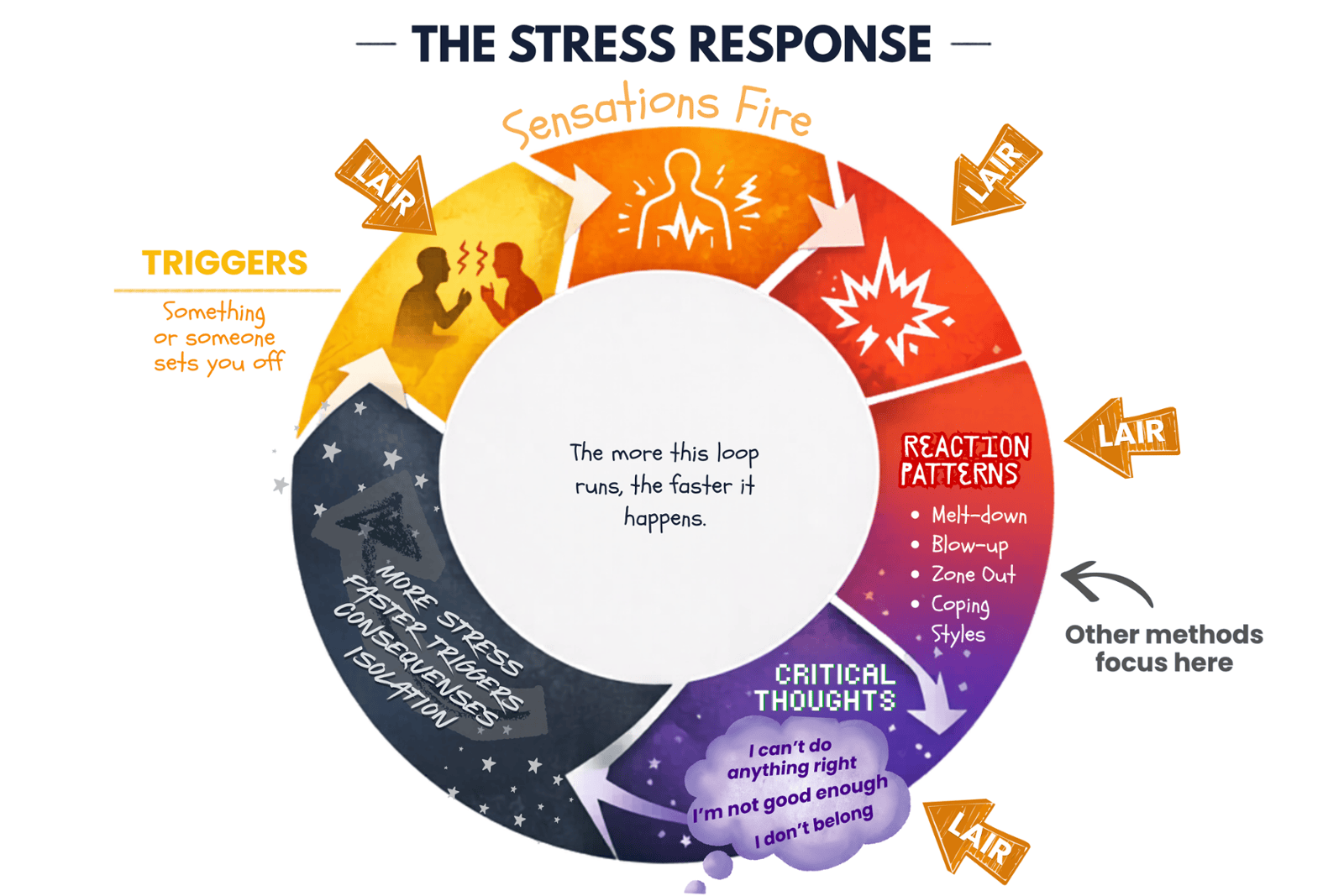
Interoception is your ability to notice signals from your body about safety.
It is the missing link in resolving stress that has a significant impact on your behavior.
Being aware of what is happening inside is how your subconscious survival based systems keep you safe.  

This awareness gets shut down by stress, overwhelm, and coping strategies aimed at suppressing or controlling your emotions. Through interoception, you can interpret your stress response system's cues for staying safe, the unspoken language of your subconscious.

It can look like noticing that split-second shift:
  • Your chest tightens, or your heart races.

  • Your stomach drops.

  • The hairs on the back of your neck stand up.

  • Heat in your face.

  • Your energy spikes or shuts down.

Those signals matter, but are often the ones we try to avoid the most.

Awareness is just the first step.
LAIR is a type of online training that helps your nervous system recalibrate the responses to get you out of feeling chronically stressed and overreactive.
You get to learn through experience, how your nervous system resets hypervigilance, entangled emotions, and your inner critic.

Why improved interoception changes everything.

As your emotions and sensation start feeling safe again, your system will stop:

  • fighting itself
  • shutting things down
  • spiralling


Because the reaction never builds in the same way. The patterns change. The reactions change.

LAIR works with your stress response system, not just your thoughts and understanding, because stress patterns don't exist only in what you know.

They also exist in how your nervous system has learned to respond.

Examples.


It's not about becoming fake-calm, extra compliant, or weirdly positive.
It is about feeling more solid inside your own body.

As things start to shift, you may notice changes like:

  • Less snapping or shutting down. Things that used to set you off don't hit the same.

  • Less brain fog in stressful moments.

  • Less getting hijacked by the same triggers again and again.

  • Self-talk that is positive, even after a hard moment.

  • More repair after conflict instead of days of distance, shame, or resentment.

  • More trust that relationships can be safe, not just unpredictable.

  • You can think more clearly in the moment, and make better choices.

  • You stop getting pulled into the same old cycles. Less regret. Fewer blow ups.


Your inner critic matters too.

The outside stress is only part of the problem.
The other part is the voice inside your head saying, “You always mess this up,” “No one really wants you,” or “You don't deserve more.”

LAIR does not treat that voice like a personality flaw or something you can fix with post-it notes.
Negative self-talk often grows out of repeated hurt, disconnect, and unsafe relationships. Interoception opens the door to rebooting it.

When your system starts feeling safer, it's possible to reset those old beliefs, and get a fresh start. Then it becomes easier to build relationships that feel steady instead of disappointing.

Skeptical?

Some teens initially write off the interoceptive method. They feel like they 
“already know all this stuff.”


A lot of smart teens know exactly what their patterns are. However, the problem is not always insight. 
The problem is that insight alone does not stop an automatic stress response once it is already happening.


Some teens have said, “I am not into body-based stuff.”

Fair. A lot of teens hear that and picture something awkward, slow, or boring. While it can be challenging, LAIR is not about making you sit around performing calming exercises. It is about learning how to catch what your system is doing in real life so you stop getting blindsided by it.

Most people feel like they “don't want to talk about everything bad that happened" to them.
The good news is, you don't have to relive your life story to start changing what your system does now. LAIR focuses on present-day patterns and helps you reset them.

“What if I don't trust this?”
If you've tried a lot already, being skeptical is normal. You do not have to force belief. But does this explain your experience more accurately than what you have heard before?

“What if my family relationships are part of the reason things are so difficult?”
We understand. That is exactly why LAIR does not put all the pressure on you. The goal is not to teach one person to survive a stressed-out system better. The goal is to help the whole system reboot.

link to interoception surveyDo You Speak Your Body's Language?